Welcome to the Toutle Valley!

I'm starting this blog to help visitors find the many things to do around Mount St. Helens and the Toutle Valley.  Our area is surrounded by adventure, high and low, but it's sometimes genuinely hard to find information about these special places.  Before our volcano erupted, the Spirit Lake Hwy followed the Toutle River all the way to Spirit Lake and Mount St. Helens with easy-to-find adventure around every bend.  The route was lined with campgrounds, river access, logging roads, trails open to all,  and vast areas to explore. 

Today its different--With all the passes, permits, and rules, it's a tangle of red tape to just understand where you can go for a walk.  Don't dispair!  I know all the secrets... and I might even be asking for your help to make the area more accessible. 

Consider this blog your Insider's Guide to the Toutle Valley.  

Posted By Toutle Trekker

Like most places in the West, the Mount St. Helens area has not received much snow.  I drove to Coldwater Lake and there was minimal snow, but with more expected this week, before it warms up again.  Coldwater Science Center is reportedly open weekends, but the Forest Learning Center is closed until May. The Mount St. Helens Visitor Center at Seaquest is open daily. Johnston Ridge, the main tourism viewpoint, remains closed year-round due to a bridge washout.  Lower trails around Coldwater Lake have only patchy snow.  If significant snow arrives, it is possible to cross country ski up the Spirit Lake Highway from the Hummocks Trailhead toward Johnston Ridge.


Posted By Toutle Trekker

Geothermal areas


A "collaborative" process is underway to study the geothermal potential at several sites around the state, including two at Mount St. Helens and one in the Columbia Gorge.  The High Lakes area around Forest, Hanaford, Elk and Fawn Lakes just outside the Monument boundary near Coldwater Science Center is one site, and an area east of Cougar is another.  Both locations would tap into the potential geothermal energy in faults around the volcano.  As most locals know, the High Lakes has been a cherished recreation area for generations, first before the eruption, then afterward as one of the few places to return to fish and camp.  Of course, that ended when Weyerhaeuser sold the land that once was crisscrossed with public trails.  My first camping trip was to Fawn Lake back in about 1978, when the lake could only be reached by trail.  This whole area was STUPIDLY left out of the Mount St. Helens Monument, mostly because private land there had large salvageable timber.  Although, as threats go I'm not particularly concerned that we will ever see a geothermal plant plopped on an active fault line, by the most explosive volcano in the lower 48, at 4500-foot elevation with no winter access and no existing infrastructure...but stranger things have happened. 

Here's the information:Geothermal energy collaborative process - Washington State Department of Ecology

Comment Geothermal Energy Collaborative Process Spring 2026


Posted By Toutle Trekker

Please fill out this survey:Gifford Pinchot National Forest | The Gifford Pinchot National Forest Would Like to Hear About Your 2025 Huckleberry Experience | Forest Service .

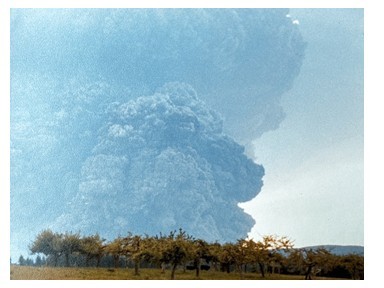
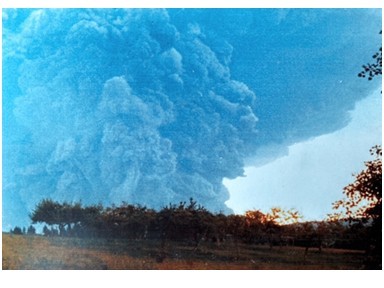
Huckleberry picking is a treasured cultural and generational activity around Mount St. Helens.  As a child in the 1970's, I remember following my mother into the berry patches at the "turnaround" at the base of the volcano. There was an old road of pumice that had huckleberries growing under the scrubby trees.  "Plink, plink," the berries would hit the bottom of my coffee can.  "Is your bottom covered yet?" my mother would ask.  More berries hit my mouth than my bucket so it took along time to fill the bottom of my bucket.  With purple fingers, we would stop at icy Spirit Lake on our way home.  We were eating those berries in hotcakes on May 18, 1980 when the mountain destroyed that whole area.  

Fortunately, huckleberry picking has returned-- not legally to the Monument--but to areas outside of that designated area.  The problem now is that areas like Strawberry Mountain and Goat Mountain  have been overrun by commercial harvesters, that strip a hillside with gangs of young men.  Local families are competing just to get a few berries for their hotcakes.  The USFS paused commercial picking last summer, and now they are collecting data on this action, and on the impacts or benefits of commercial picking.  If you have ever picked huckleberries, or want to someday, please fill out the survey.  


Posted By Toutle Trekker

New Purchase
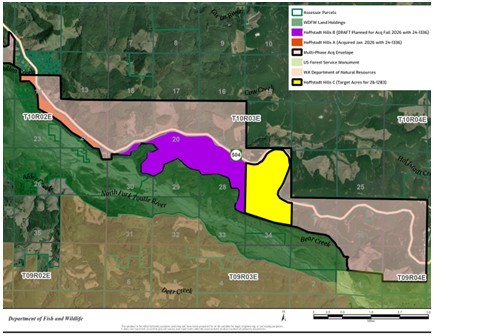
The Washington Department of Fish and Wildlife completed the first 200-acre purchase of Hoffstadt Hills, which is the land wedged between the Spirit Lake Highway and the publically owned Toutle Valley floor.  The county clerk's website now shows that this land is owned by the people of the state of Washington, but ownership apps like onX are not updated yet. 

Back in the mid-1980's the sediment retention structure (aka sediment dam) was built across the North Toutle River to slow the flow of ash and sand into the lower valley.  The funding agreement between state of Washington and the federal government required the State to provide mitigation.   Besides the fish trap program, mitigation was mostly ignored.  As a first step, the sediment plain was transferred to the WDFW for "habitat and recreation" but without public access for recreation!    The WDFW acquired an easement for research, habitat, administration and educational purposes on the 3100 logging road, but it did not, and does not, include recreation.  For years a tiny 200-foot wide strip of Weyerhaeuser land blocked access to public land from the Spirit Lake Highway.  I lobbied Weyerhaeuser to allow people to hike across that strip for free, but they doubled-down on their permit requirement and specifically added the fee to cross there.  I called it the "infamous 200 feet" because this tiny strip blocked access to thousands of acres of public land. 

 Now the road that passes through that strip is open to the public for non-motorized access, and legal public access to the Mudflow and Hoffstadt Units of the St. Helens Wildlife Area has finally been secured. 


Posted By Toutle Trekker

The new administration is cutting costs and employees across most federal agencies, and the US Forest Service is no exception.  This follows on the heels of an announcement that no seasonal staff would be hired in 2025 except for firefighting.  Of course, we on-the-ground know that seasonal workers do most of the 'real work' at the agency.  Seasonal workers cater to summertime visitors to national forests by clearing trails, answering questions, and cleaning restrooms.  Permanent staff are often bound to a desk in an office.  When I worked for the Forest Service (as a seasonal employee), it was this way, too.  College students helping the public and cleaning up, while permanent staff dealt with all the processes of government in the back, like purchasing.  If we ran out of pencils, there was no stopping at Walmart to pick some up.  Everything had to be ordered from a special catalog of 'approved' sellers.  Ugh.  

To add my two cents to this cost-cutting debate, I believe what an agency like the USFS needs is not so much to cut "waste, fraud, and abuse" but to cut PROCESS.  Any look on the Forest Service website under their projects page gives you an idea of the monumental pile of paper and staff time that is needed to just complete a simple task.  For example, the plan to remove the rotting Elk Bench restroom on the Lakes Trail is over a dozen pages.  The project is ok'ed for a quick "categorical exclusion" instead of a full NEPA review, but even so, it required SEVEN additional legal considerations beyond NEPA.  On top of this, NINE separate government specialists, from a botanist, archeologist, hydrologist, biologist, to historian and recreation specialist had to review it.  Most chose not to make a site visit, but imagine the staff time costs for these specialists just to reach a remote site like this: driving, hiking, and poking around.  EIGHT presidential executive orders had to be considered, ranging from migratory birds and hunting access to tribal consultation and environmental justice.  The entire toilet removal process will take about two years (they hope to actually remove the toilet in June of 2026.)

Now imagine what it would take for the USFS to do something a bit larger, like fix a washed out road or bridge.  A forester once told me what it was like to work on such a thing with the USFS.  He had a Forest Service easement road go through his private timberland before it reached the national forest.  They both used the road and it washed out in a bad rainstorm.  The USFS engineer came out and looked at the problem.  "This is a bad one; it will take two years; cost over a million dollars".  The private forester knew it was a fix his road contractor (following all state laws) could have done in a few weeks at a fraction of the cost.  The private forester offered to fix the washout and cost share with the federal agency.  Finding a way around the bloated federal process saved everyone alot of time and money with the same end result: an repaired road and a clean environment.  I hope some of that logic makes into the current cost-cutting push.


Google

User Profile
Toutle Trekker

 
Category
 
Visitors

You have 216608 hits.