Welcome to the Toutle Valley!
I'm starting this blog to help visitors find the many things to do around Mount St. Helens and the Toutle Valley. Our area is surrounded by adventure, high and low, but it's sometimes genuinely hard to find information about these special places. Before our volcano erupted, the Spirit Lake Hwy followed the Toutle River all the way to Spirit Lake and Mount St. Helens with easy-to-find adventure around every bend. The route was lined with campgrounds, river access, logging roads, trails open to all, and vast areas to explore.
Today its different--With all the passes, permits, and rules, it's a tangle of red tape to just understand where you can go for a walk. Don't dispair! I know all the secrets... and I might even be asking for your help to make the area more accessible.
Consider this blog your Insider's Guide to the Toutle Valley.
|
February 8, 2023 05:32:06
Posted By Toutle Trekker
|
Back when I was a kid, I testified in front of a Colonel Friedenwald of the Army Corps of Engineers in Longview, Wa. My Grandma stood up, too. Cousins, my mother, and other Toutle citizens, bravely testified against a project that was popular in that city. We were fighting to save our river. The Army Corps was proposing a huge dam across the North Toutle River to trap sediment that was washing into the Cowlitz and Columbia Rivers. The dam would irreparably alter the Toutle Valley, force out one of the last homestead families, and cut off salmon and steelhead from vital spawning streams. Yes, the eruption had damaged the river, but we could see, even back then, that the river could heal itself. A local engineer and author, Alden Jones, gave tours to officials to highlight the natural recovery already taking place in the early 1980's. Nature had done it with past eruptions, and it was fully capable of recovery if given a chance.
But the needs of downstream shipping channels and towns were much more important that the future of the upper Toutle watershed.
We put all our efforts into stopping the sediment dam, and (not recognizing our own impotence and insignificance) the Toutle community didn't push for mitigation for the permanent impacts of the dam. The Reagan administration specifically refused to fund any mitigation, so it was passed onto the state and local partners, then ultimately mostly ignored. (see my post Timber Giant Blocks Legal Public Access, June 2021)
Today you can hike across the dam and see first hand the huge sediment plain that was once the Toutle River Valley. My previous post 'sediment dam hike' has the details.
Our fruitless battle was fought before some of the region's salmon, steelhead, and other river-dependent species were listed under the Endangered Species Act. I would like to believe that things would be different today.
We may have a chance to find out. The law that guided the Army Corps is set to be reviewed in 2035 and a new "cooperative" approach is being tried. The idea is to bring all parties together and work toward common goals that take into account community, economic, recreation, habitat and safety needs. The group is managed by the William D. Ruckelshaus center and it is called the SLTCRC: Spirit Lake/Toutle-Cowlitz River Collaborative. I'm not part of the group, but I'm keeping a close watch on their activities. Hopefully, this time around, the future upper Toutle River will not be sacrificed further, but I'm not holding my breath.
April 2023 update: I attended a two day workshop with the group to comment and advocate for recreational access, but am not a part of it...yet. May 5 update: opps, I lied. Now I am involved in a workgroup.
Check it out:
Spirit Lake/Toutle-Cowlitz River Collaborative (SLTCRC) | The William D. Ruckelshaus Center | Washington State University (wsu.edu)
Updated website: Spirit Lake / Toutle-Cowlitz River Collaborative • Cowlitz-Wahkiakum Council of Governments
|
|
January 15, 2023 10:58:57
Posted By Toutle Trekker
|
The Department of Natural Resources, which oversees most state land as well as all our navigible and saltwater areas, is working with a consultant to write a statewide Outdoor Access and Responsible Recreation plan. I've reached out to the lead with some of my findings on landlocked state land, which you can see detailed in my posts under "land access". According a study by OnX Company, the state of Washington has 316,000 acres of landlocked state land. We need to start with obtaining legal public access to this land! Right here in the Toutle Valley the DNR has 35,000 acres of landlocked state land where access is controlled by the largest landowner in the United States--Weyerhaeuser Timberlands. We need Access First! Basic legal access is required and needed before any facilities can even be considered. Information about public meetings is here:
Outdoor Access and Responsible Recreation Strategic Plan | WA - DNR
The Forest Service is modernizing the Northwest Forest Plan. Mount St. Helens, which had their 1985 plan rolled into the Forest Plan has never been updated. My biggest comment would be "a little less talk (or study) and alot more action (on the ground)". Geologic time moves faster than the Forest Service! As an example, Mount St Helens was erupting in 1985, went dormant for over 20 years, started erupting again and then went back to sleep, all while the USFS was stuck in the past. Comment by February 2.
US Forest Service NEPA Projects Home (usda.gov)
|
|
August 10, 2022 09:36:13
Posted By Toutle Trekker
|
Tourism at Mount St. Helens hasn't panned out. I've been involved with this industry from the start. As a kid, my sister and I hammered together a few boards, painted "volcano stand" on them, and converted our bus shed into a "business" in the summer of 1980. We sold baggies of ash, copies of family eruption photos, and (of course) lemonaid. By the next year, the adults had taken over, and 19 Mile House was born. Over the years, I've seen millions of tax dollars pour into tourism facilities. A new highway 504 was dotted with FIVE visitor centers! But these monsterous buildings seem to miss the mark. Cowlitz County's tax-funded visitor center has been sold to a church group. The Forest Service built three of these centers, but today operates only one, at Johnston Ridge. People drive up, watch the movie, and then leave, without sustaining any real long-term economic activity. All the while I've been traveling the Western USA looking at other areas and comparing what they have done--right or wrong--with Mount St. Helens.
Here's what I have learned:
#1 People want REAL experiences. Pavement recreation won't do. Car rides and visitor centers and video screens are not a real experience. Yes, fly-by tourists will drive up, spend an hour, and turn around. But nobody stays and plays...and pays. People want to do real activities: camping, lodging, hiking, boating, skiing, sledding, biking, horseback riding, kayaking, fishing, hunting, birding, climbing, berry picking, dining, swimming, backpacking.
#2 Campgrounds. The biggest whiff at Mount St. Helens is lack of camping. The Monument intentionally didn't provide any campgrounds, and instead relied on private business for camping. The leadership made this decision despite the fact that the Monument Act specifically instructs the Forest Service to provide campgrounds. I've been to nearly all the National Parks Units in the West and they all have some sort of camping. Even Craters of the Moon, in a bleak, hot, black lava bed, has carved out camping spots.
#3 Year-round activities. The successful outdoor recreation areas find ways to bring in people year round. Ski resorts offer mountain biking and chairlift rides in the summer, Spring flowers and bird arrivals are promoted. Fall colors and bugling bulls attract a wide variety of visitors. Fortunately, Mount St. Helens has the ability to capitalize on the changing seasons. Instead, along the Spirit Lake Highway, the Forest Service has made winter activities illegal! No sledding, No snow play. No ski trails. No snowmobiles. No. No. No. No wonder there are no visitors.
#4 Access. Last but not least, access is key. Access to trails, access to lakes, access to and through the area. Mount St. Helens in the opposite of accessible; it is locked up and closed off, all going against it own Management Plan. The area is regulated to death, and people are turned off by all the threatening signs. They simply feel unwelcome with threats of $100 fines for stepping off the trail around every bend.** Here's the kicker, it was never supposed to be that way. The 1985 Monument Management Plan is much more reasonable than what is on-the-ground today. It calls for a trail along the shore of Spirit Lake for fishing, has a snowpark at Coldwater Lake, a dock and camping spot at the end of the lake, a trail to connect north and south areas, and easements to trailheads if they are ever blocked by private landowners (which they are now). Currently, there are entire regions of the Monument that are locked behind private gates with trailheads only usable by people who purchase $350 private Weyerhaeuser permits.
A Brighter Future? Currently, the Mount St. Helens Institute, a non-profit that has taken over management of the old Coldwater Ridge Visitor Center, is proposing some of these very items for the site, including overnight lodging and a campground. Although this is in the future, any move to add real experiences can only help the region. I, however, would suggest the Forest Service spend a minimum amount on securing access to existing trailheads, which would broadly expand things to do, with very minimum of investment. Beyond that, a designated winter snowplay area is also an inexpensive and key addition.
**I'm still investigating but it appears the decades of "administrative closure" were actually illegal (no kidding!) As of July, 2022, the Monument has not renewed its administrative closures on much of the Monument, including all the land along the Spirit Lake Highway. This may be true, but I haven't seen any $100 fine signs come down yet.
|
|
October 17, 2019 08:14:19
Posted By Toutle Trekker
|
So now it is time to jump into some bit of controversy concerning access to our public lands in the Toutle Valley (and around the state). I've already talked about "official" access routes to various parcels of state and federal land in the valley, but, behind the scenes, I have been pushing government agencies and elected officials about a more hidden layer of access: road easements. It turns out that many of the gated roads that you might run into that are posted by Weyerhaeuser may have state easements on them that go to public land. These roads are currently posted with signs that claim that a Weyerhaeuser permit is required for all recreational access, even if these roads go to state land. In fact, the gate nearest the sediment dam (below) blocks a road with TWO government easements on it, both of which could allow public access to adjacent public land. Weyerhaeuser owns the land on the right side of the road. Now, keep in mind, these easements do not let folks walk or hunt or hike on private land, they only allow access through on certain roads leading to public land.
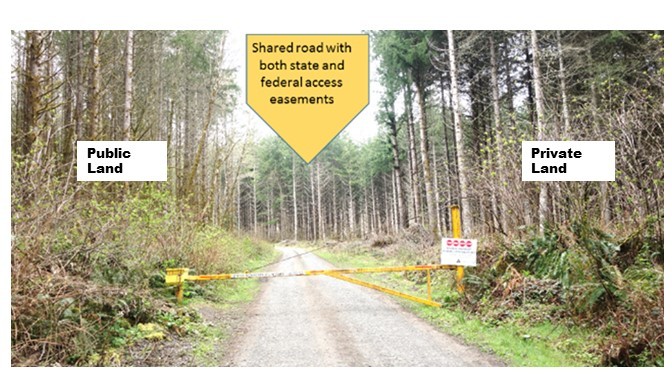
Most of these easements are between timber companies and the state Department of Natural Resources. Many were written in the 1960's and 1970's when both entities where logging new territory, and they needed to pass each other's lands. One relavent easement, the Green River Easement, was written in October of 1967 and has no restrictions on how the road can be used. The easement simply provides access to and from lands of the parties. The DNR says that public use of these easements is a "grey" area, but a closer look at the history shows that broadly worded easements were written this way in response to pro-recreation laws that passed the Washington legislature in mid-1967. Unfortunately, easements written before mid-1967 often have restrictive language that limits use to "land management and administrative activities".
What this means for the Toutle Valley: Right now access to our state lands is mostly at the whim of Weyerhaeuser. The WDFW does have and "administrative-type" easement on the 3100 road, but the public directly isn't covered by that. If the DNR could confirm that the public could at least walk or bicycle on roads covered under the Green River Easement, access routes would open up to the Winston Block of DNR land (16,000 acres just north of Kid Valley), the 8,000-acre Wildlife Area would have three or four additional access routes, and the 35,000-acre Toutle State Forest could be accessed from Sediment Dam Road.
It's complicated, but right now is the time to contact your legislator, the heads of the DNR, and WDFW and to encourage them to confirm that the public may used these easement routes to access state land.
|
|
|
|

